Hotel Explosion in Manali: Is Uncontrolled Tourism Construction Threatening the Future of the Valley?
Manali, Himachal Pradesh: The breathtaking mountains, green valleys, rivers and traditional villages of Manali have made it one of India's most popular tourist destinations. However, the rapid expansion of hotels, resorts, cottages, homestays, bed-and-breakfast properties and holiday rentals raises an important question: Is Manali developing beyond the capacity of its natural environment and public infrastructure?
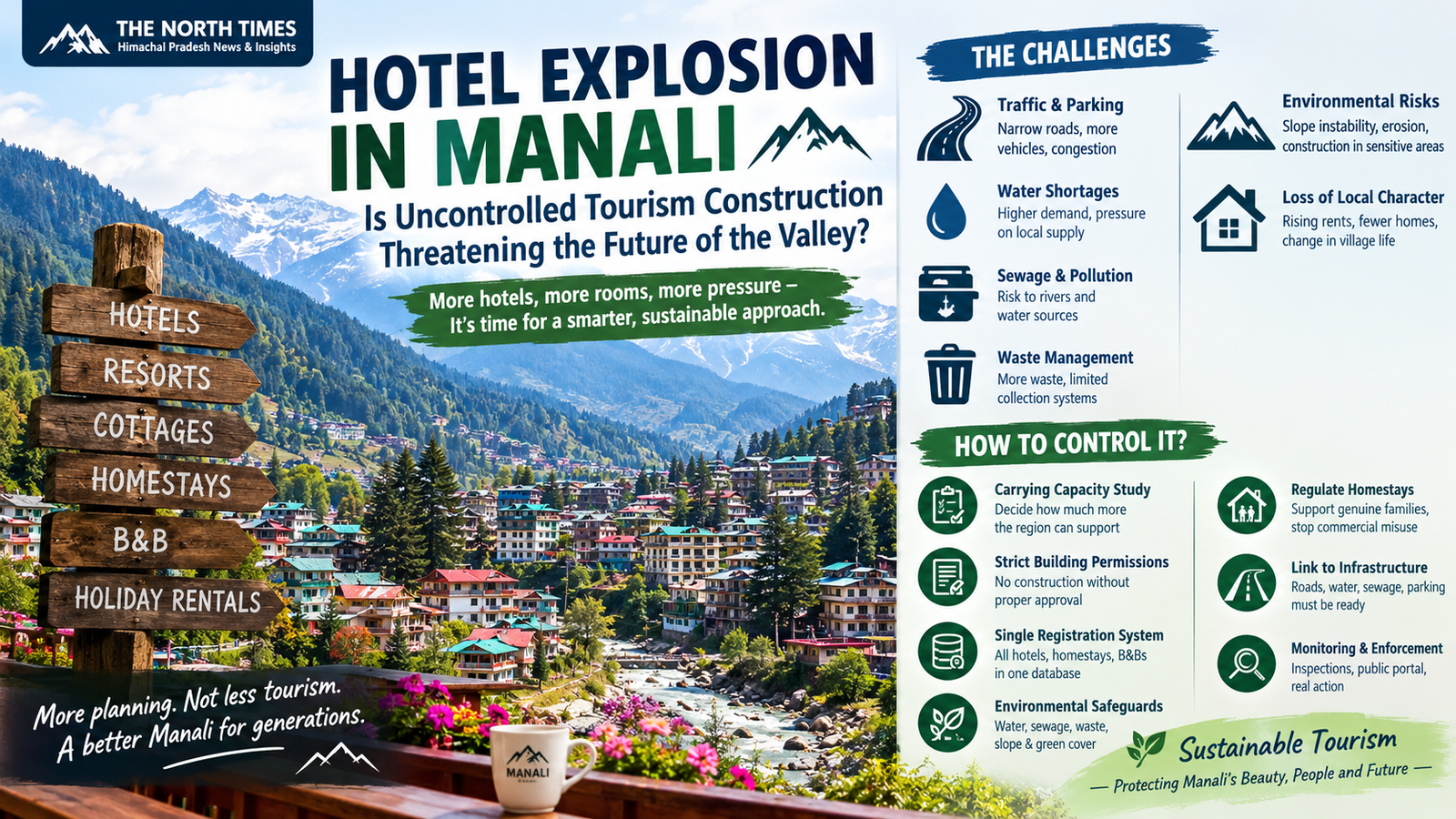
The real concern is not the number of tourists alone. It is the growing number of accommodation facilities and buildings without adequate planning for roads, parking, water supply, sewage, waste disposal and environmental protection.
If this growth continues without effective regulation, the region could face increasing pressure on its fragile mountain environment, village infrastructure and quality of life.
1. The accommodation boom: When every building becomes a hotel
Across the wider Manali region, tourism accommodation takes many forms:
Large hotels and luxury resorts
Independent cottages and private villas
Homestays and bed-and-breakfast establishments
Guesthouses and small lodges
Apartments and rooms rented to tourists
Holiday homes operated through online booking platforms
These businesses create employment and income for local families. However, unplanned expansion can create serious problems when accommodation grows faster than the infrastructure needed to support it.
A building designed for residential use may end up accommodating dozens of tourists. Several properties in one small village can collectively generate more traffic, sewage and water demand than the local infrastructure can handle.
The objective should therefore be to distinguish responsible tourism development from uncontrolled commercial construction.
2. Why excessive hotel construction is a concern
Pressure on roads and parking
Narrow mountain roads and village lanes were not necessarily designed for continuous tourist traffic, taxis, delivery vehicles and hotel parking demand. More rooms can mean more vehicles, congestion and difficult access for emergency services.
Water shortages
Hotels and holiday properties require water for bathrooms, kitchens, laundry and cleaning. During dry periods, increased commercial demand can compete with the needs of residents and agriculture.
Sewage and pollution
Every occupied room generates wastewater. Where sewage systems and treatment facilities are inadequate, untreated discharge can threaten rivers, streams and local water quality.
Waste management
Tourism generates plastic packaging, food waste, bottles and other rubbish. If collection and processing do not keep pace with new accommodation, the burden falls on local communities and the surrounding environment.
Pressure on the mountain landscape
Construction on steep slopes, near watercourses or in environmentally sensitive areas can increase risks associated with erosion, drainage failures and slope instability. Site-specific geological and engineering assessments are essential.
Changing village life
When residential properties increasingly become commercial tourist accommodation, local housing availability, rents, traditional architecture and community character may also be affected.
3. How can excessive hotel construction in Manali be controlled?
The solution requires a coordinated policy involving the Himachal Pradesh government, Town and Country Planning Department, Tourism Department, municipal authorities, panchayats and environmental agencies.
A. Introduce a carrying-capacity-based accommodation policy
Authorities should commission a scientific study to determine how much additional accommodation each settlement can safely support.
The study should consider:
Available drinking water
Sewage treatment capacity
Road capacity and emergency access
Parking availability
Waste collection and processing
Slope stability and environmental sensitivity
Seasonal tourist demand and resident population
Based on these findings, authorities could establish area-specific limits on new accommodation approvals.
Areas with sufficient infrastructure could permit carefully planned development. Highly congested or environmentally sensitive locations could face temporary restrictions or stricter conditions, subject to applicable law.
The principle should be simple: no new commercial accommodation without adequate infrastructure and environmental safeguards.
B. Enforce building permissions strictly
Himachal Pradesh already has a planning framework under the Town and Country Planning Act, 1977. The state's official urban development guidance says construction or development in notified planning, special or deemed planning areas requires prior permission from the competent authority.
Authorities should enforce applicable building plans, land-use rules and approved floor-area limits consistently.
Priority actions should include:
Identifying buildings constructed without required permissions.
Checking whether actual floors, room counts and commercial uses match approved plans.
Investigating unauthorised conversion of residential buildings into tourist accommodation.
Taking proportionate legal action against proven violations.
Preventing retrospective regularisation from becoming an incentive to violate planning rules.
Every case should follow due process, applicable law and any relevant court orders.
C. Create a single accommodation registration system
Hotels, resorts, cottages, homestays, B&Bs and tourist guesthouses should be recorded in a unified, searchable district database, with the applicable registration requirements determined by the type of property.
The database should record:
Property name and location
Owner or authorised operator
Approved building use and capacity
Number of permitted guest rooms
Tourism registration status
Applicable fire and safety clearances
Wastewater and waste-management arrangements
Inspection and renewal dates
The system should also help authorities identify properties advertised online but missing required registrations or permissions.
The Tourism Department already publishes registration procedures and documentation requirements for tourism units. These existing systems provide a foundation for stronger coordination and enforcement.
D. Regulate homestays without harming genuine local families
Homestays can help residents earn an income from tourism and preserve local traditions. They should not automatically be treated as large commercial hotels.
However, authorities should verify that a property meets the applicable legal definition of a homestay and complies with the relevant rules.
A practical policy could distinguish between:
Genuine owner-operated family homestays
Registered bed-and-breakfast establishments
Professionally operated holiday rentals
Commercial cottage complexes and hotels
Different categories may need different standards, but none should be allowed to bypass applicable land-use, building-safety or registration requirements simply because it is advertised as a homestay.
Himachal Pradesh notified its Home Stay Rules, 2025. These rules and subsequent amendments or government directions should be reviewed before introducing any new restrictions.
E. Link new approvals to infrastructure capacity
Before approving a new hotel or cottage complex, the responsible authorities should assess its additional demand on public services.
For example, a proposed 40-room hotel should demonstrate how it will manage guest traffic, parking, drinking water, wastewater, solid waste and emergency access.
Where infrastructure is insufficient, authorities could require the developer to provide compliant on-site facilities, contribute to legally authorised infrastructure improvements or defer approval until adequate capacity is available.
Permissions should not be granted solely because a developer owns land or can finance construction.
F. Establish a transparent monitoring and enforcement system
A district-level monitoring team could coordinate inspections by the relevant planning, tourism, municipal, panchayat, fire and pollution-control authorities.
A public reporting portal could allow residents to flag suspected unauthorised construction, unsafe buildings, blocked drainage and unregistered commercial accommodation.
Each complaint should receive a tracking number and be investigated by the appropriate authority. Verified violations should lead to action under the applicable law, while false or disputed allegations should be handled fairly.
Inspection priorities should focus on high-risk buildings, environmentally sensitive locations and areas where construction is expanding rapidly.
G. Introduce stricter environmental safeguards
New accommodation approvals should consider the environmental sensitivity of each site.
Depending on the location and applicable legal requirements, safeguards may include:
Geological and slope-stability assessments
Adequate stormwater drainage
Sewage treatment and safe wastewater disposal
Rainwater harvesting where appropriate
Energy-efficient building design
Waste segregation and authorised disposal
Protection of riverbanks, forests and natural drainage channels
Construction in prohibited or legally protected areas should not be permitted merely to satisfy tourism demand.
4. Should Manali stop approving new hotels?
A blanket ban across the entire Manali region may be too simplistic. Different settlements have different levels of congestion, infrastructure and environmental sensitivity.
A better approach would be to classify locations into three broad planning categories.
Category 1: High-pressure areas
Locations with severe congestion, inadequate utilities or significant environmental constraints could face a temporary pause or tighter limits on additional accommodation approvals, where legally justified.
Category 2: Infrastructure-ready areas
Locations with adequate roads, water, sewage, parking and emergency access could permit development that meets planning and environmental requirements.
Category 3: Environmentally sensitive areas
Locations exposed to significant slope instability, protected habitats, river-related hazards or other constraints should be governed by the relevant restrictions and scientific assessments.
These categories would need to be established through an official, evidence-based planning exercise rather than arbitrary decisions.
5. A practical 12-month action plan
Time frameRecommended actionFirst 3 monthsMap existing hotels, cottages, homestays and other tourist accommodation; identify suspected violations and infrastructure gaps.Months 3–6Assess carrying capacity, review land-use plans, inspect high-risk properties and publish a verified accommodation database.Months 6–9Develop area-specific approval criteria, strengthen inspections and improve coordination between departments.Months 9–12Implement legally approved restrictions, improve wastewater and waste infrastructure, and publish annual compliance and capacity reports.
This is a proposed implementation timeline, not a statement of an existing government programme.
6. Protect local people while protecting tourism
Regulation must be fair. Local families who operate lawful homestays should not face the same compliance burden as large commercial developments where the risks and scale are substantially different.
Authorities should provide clear rules, transparent approvals and reasonable compliance periods where appropriate.
At the same time, illegal construction, unsafe buildings and commercial operations that violate applicable requirements should not receive preferential treatment.
The long-term aim should be to preserve local livelihoods while ensuring that tourism does not overwhelm the natural resources and public services on which the industry itself depends.
Conclusion: Manali needs planned tourism, not unlimited construction
Manali's greatest attraction is its natural beauty, mountain environment and local culture. Uncontrolled accommodation growth can undermine all three if development outpaces infrastructure and environmental safeguards.
The answer is not to eliminate tourism or punish every hotel owner. It is to enforce planning laws, register accommodation properly, assess carrying capacity, regulate commercial conversions and make infrastructure a prerequisite for future growth.
The Himachal Pradesh government should consider a comprehensive, publicly accountable tourism-accommodation policy for the Manali region, developed with local communities, business owners, technical experts and environmental authorities.
Manali must remain a place where tourism supports the valley, rather than a place where the valley is forced to support unlimited tourism.
MORE FROM THE BLOG

MORE FROM NORTHERN DIGEST